Read the complete review at my blog."Freedom is a wonderfully rich novel. The characters are complex, interesting, and the writing is superb. This book is definitely one to read."

We are lifting weights, jumping rope, and punching the bags to meet the reading challenge.
Wednesday, February 22, 2012
Freedom / Jonathon Franzen. New York: Picador, 2011 (608 p.)


Tuesday, February 21, 2012
Wildlife Photography: From Snapshots to Great Shots
 |
Wildlife Photography:
From Snapshots to Great Shots/Laurie Excell, Berkeley: Peachpit Press, 2012 (229 p.)
|
Excell considers Peterson to be one of her mentors so you
will see many parallels between their books with regard to equipment,
locations, etc., but Excell does not put as much emphasis on using photography
as a component of wildlife studies.
Instead, she focuses more on photography rather than projects
surrounding the photography.
As in her other book, Composition, each chapter contains
practical exercises to help photographers develop or fine tune their skills. Excell closes this book with information on
two specific wildlife photography excursions, photographing bears in Alaska and
photographing birds in Texas. I found
these two chapters were easy to read and gave photographers a better idea of
what to expect should they decide to take one of these trips.
Peachpit Press rates this book as a “Beginner” level volume
which is probably accurate although I believe it offers useful information to
the more experienced photographer as well.
My only lingering question is whether I would recommend that a
photographer read this book before or after Peterson’s Captured.
Monday, February 20, 2012
How It All Began / Penelope Lively. London: Peguin Books. 2012. (247 p.)
This latest book by Penelope Lively was highly rated by the NY Times. It was my first Lively read and she was a Booker Prize winner in 1987 for Tiger Moon. Her latest novel centers around the lives of eight characters whose emotional, intellectual, and/or physical lives are intertwined in some fashion. This work is beautifully crafted. I do appreciate a story which is about the lives of people whose ages span middle years to elderly. However, for this reader the character development and story lines were a bit too restrained. How It All Began lacks a visceral quality that I find necessary to a good read. Having said this, I am still willing to go back to some of her earlier works. Read How It All Began yourself and see what you think.
The Truth about Forever / Sarah Dessen. New York: Puffin, 2004. (374 p.)

Macy Queen is not looking forward to her summer. Her "perfect" boyfriend wants to take a break while he is off at brain camp. She is stuck working at the local library circulation desk with two judgmental classmates. Her mother won't take vacation from her 24/7 real estate job. All this happens in the wake of her father's unexpected death.
Her summer quickly changes with the chance to work at Wish, a disorganized local catering company with a motley crew of characters, and her new friendship with the mysterious local artist Wes.
I read a lot of young adults books. This book was a welcome escape to one summer with Macy and her new friends.
Thursday, February 16, 2012
Captured: Lessons from Behind the Lens
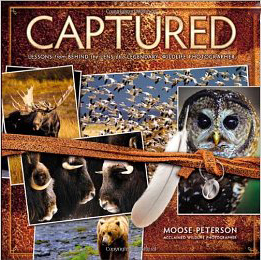 |
Captured: Lessons from
Behind the Lens of a Legendary Wildlife Photographer/B. Moose
Peterson, Berkeley: New Riders, 2010
(396 p.)
|
There are some concerns with the book so let’s get those out of the way first:
1)
If you are looking for a step-by-step
instruction book, this is not it.
Technical details and “rules” are not the emphasis of this book. Some material also assumes some basic
knowledge which may make the book less than optimal for a beginning wildlife
photographer.
2)
The book contains lots of photos but is printed
on a matte paper which, for some, detracts from the photo quality. Personally I did not find this to be a
problem because I purchased the book for content, not to use as a coffee table
book
3)
Peterson is a Nikon shooter so if you use
equipment from another manufacturer some of the details will need to be translated
into what fits your equipment. Again, I
did not find this to be problematic since equipment options from Nikon and
Canon are similar. At the same time,
several pages are devoted to screen shots of Nikon menus which are not useful
to people who do not use Nikon equipment.
Having that out of the way, I found about 90% of this book
to be highly enjoyable. Peterson is at
his best when telling stories of projects he has worked on and describing
events and the environment. Interspersed
with these folksy tales are bits of technical wisdom that wildlife
photographers may find highly useful (I have already made a couple of changes
based on ideas he presented). Where the
book does not shine is when he attempts to go deep into theory or
technology. Luckily, Peterson warns you
about this in the text.
While the book is long (396 pages, not the 312 shown on
Amazon’s site), there are few, if any, pages without one or more photos. Peterson uses these photos to compare “good”
with “better”. While admitting to not
deleting “bad” photos, Peterson also says you will never see the “bad”. These photos also make this book one that you
can pick up and browse for enjoyment without reading a word of text other than
the photo captions.
As I said earlier, I would recommend this book to almost
anyone interested in wildlife photography.
My only caveat would be that the beginner looking for a “how to” guide
may be disappointed.
Friday, February 10, 2012
I wanted to like it... it just seemed so good but it wasn't
 IQ84 by Murakami, Haruki; Rubin, Jay (Translator); Gabriel, Philip (Translator), Knopf; First Edition edition (October 25, 2011)
I want to like IQ84. It is chilling and mysterious. There is a lady assassin in love with a man who is a mathematician by day and a fiction writer by night. There are twists and turns of a parallel universe which keep the lovers apart. It has rightful vengeance and a clever detective. But for me, it ended with a fizzle of huhs.
The two main characters, Aomame the assassin and Tengo the writer/mathematician alternate narrating the details of a their long lost love and trying to find each other in a parallel universe by a religious cult and little three centimeter people who channel back and forth between worlds through passageways of dead dogs and lambs. Huh? Make sense yet? No, and unfortunately the book doesn’t try to make sense out of all the fantastical elements that are spun into the plot. And, that is too bad because these odd mystifying elements are, satisfyingly curious. In the beginning, you eagerly follow along the fantastic plot that strings fascinating vignettes into one large convoluted plot web. Who and what are these little people and why did they snatch away a zombie girl from a rescue house? Who is the ugly detective with looks so gross and that he can’t risk undercover work because everyone remembers his ugliness. How can the religious cult leader’s runaway daughter be a conduit for the star crossed lovers? Or, is she human or just a zombie copy of what she was. Lost yet? Well, now you know how I felt at the end of the book- puzzled and annoyed at reading 1,200 pages of murky plotting.
Anyway, I did love the small vignettes of the different characters lives: Aomome, the diligent assassin working to right the wrongs of the world… Tengo’s weekly visit to his father’s deathbed in a cat filled town and many more few page scenes that kept me curious. But in the end, all the terrific scenes just sputtered out.
Reviewer’s note—IQ84 is the first book I’ve read by Haruki Murakami and I’ve been told that some of his other works are better, much better.
Tuesday, February 7, 2012
Letters from a Cat / H.H. (Helen Hunt Jackson)
 Letters from a Cat: Published by Her Mistress for the Benefit of All Cats and the Amusement of Little Children/ H.H. (Helen Hunt Jackson). Boston: Roberts Brothers 1880. (89 p.)
I can't resist a book written from the animal's point of view. If the animal tells the story, I figure he's unlikely to die in the last few pages. But the introduction of Letters from a Cat is written from a human's perspective, and unfortunately it reveals the sad post script to the cat's letters.
Except for the introduction, Letters from a Cat is exactly that: Letters from a cat to her child guardian who on a trip with her father. The voice of the cat, Pussy, is endearing in its Victorian formality. Through her cat's eyes, Pussy is a keen observer of the human animals around her.
Subscribe to:
Posts (Atom)