Showing posts with label photography techniques. Show all posts

Friday, July 6, 2012

The Digital Photography Book, Volume 4

The Digital Photography Book, Volume 4/Scott Kelby, Berkeley: Peachpit Press, 2012, 219 p.
This volume continues the format of the three earlier volumes with each chapter dedicated to a single major subject and composed of a series of one page vignettes that can be read in order or reviewed individually. Like Volumes 2 and 3, Volume 4, picks up where the previous books ended and assumes the reader has either read the previous volumes or has a solid understanding of the tips there.

The first three chapters in volume 4 (Shooting People, Using Hot Shoe Flash, and Using Your Studio) concentrate on photographing people, primarily in a studio situation. While I’m sure the tips offered here are excellent, I have little experience to draw on in this area since my principal focus is outdoor and nature photography. Chapter 4 supplements the information provided in Volume 3 on lenses and associated topics. It is followed by chapters on natural light, landscapes, travel, and sports. Two chapters new to this volume cover HDR (High Dynamic Range) photography and digital video. As Kelby indicates most photographers fall into one of two camps – those who love HDR and those who hate HDR. While I have seen some good HDR, my leanings are toward the latter group because most HDR work I have seen is poorly done. Although my camera has video capabilities, I have elected to not pursue this.

Continuing previous practices, this volume closes with two chapters covering pro tips and photo recipes, or techniques used to capture selected sample images. These two chapters provide some of the most useful and easiest to read information because you have clear examples of the technique being covered.

While Peachpit rates this book as a Beginner Level volume (consistent with the other three volumes), my view is that, like Volume 3 it moves into areas that are for slightly more advanced photographers. Even so, I wouldn’t hesitate recommending the series to any digital photographer.
As I noted in my review of volume 2, you can purchase all volumes in the series as a boxed set at with some possible savings. These books are also available in eBook form (for both Kindle and Nook readers).

Friday, March 16, 2012

The Digital Photography Book, Volume 3


The Digital Photography Book, Volume 3/Scott Kelby, Berkeley:  Peachpit Press, 2009 (243 p.)
This is the lengthiest of Scott Kelby’s first three volumes of The Digital Photography Book.  Volume 3, again picks up where the previous books ended and assumes the reader has either read the previous volumes or has a solid understanding of the tips there.

The chapters in volume 3 closely parallel those in volume 2 but there is a little less emphasis on “people photography” and a shift back to a bit broader coverage of topics.  One chapter which many less experienced photographers will find quite useful covers lenses and associated topics.  Also, previous information on shooting landscapes has been expanded to include the more general topic of outdoor photography.

Continuing previous practices, this volume closes with two chapters covering pro tips and photo recipes, or techniques used to capture selected sample images.  In both volumes, these two chapters provide some of the most useful and easiest to read information.  This is the one area where Kelby slips back into an emphasis on portraits and studio work.

While Peachpit rates this book as a Beginner Level volume (consistent with volumes 1 and 2), my view is that it is starting to move into areas that are for slightly more advanced photographers.  Even so, I wouldn’t hesitate recommending the series to any digital photographer.

As I noted in my review of volume 2, you can purchase volumes 1, 2, and 3 as a boxed set at considerable savings.  These books are also available in eBook form (for both Kindle and Nook readers). 

Monday, March 12, 2012

Digital Photography Book, Vol. 2


The Digital Photography Book, Volume 2/Scott Kelby, Berkeley:  Peachpit Press, 2007 (223 p.)
To quote Scott Kelby from Chapter 1, “This is volume 2 of The Digital Photography Book and it picks up where the last book left off (so it’s not an update of that book, it’s new stuff …”  In the same manner as volume 1, Kelby approaches this volume as though he and the reader were out together on a photo shoot and the reader asked how to do a particular task.  The result is an easy to read volume, not overloaded with technical details but instead filled with useful information.  At 223 pages, you get another 200 or so helpful hints or ideas on how to make your photography better.

Volume 1 provided broad coverage of almost every photographic subject.  While volume 2 continues this coverage of multiple areas, the emphasis leans strongly toward “people photography” with longer chapters on lighting, building a studio, portraiture, and wedding photography.  It also includes shorter chapters on landscape, travel, and macro photography but these are clearly not the emphasis of this volume.
Like volume 1, volume 2 closes with two chapters covering pro tips and photo recipes, or techniques used to capture selected sample images.  In both volumes, these two chapters provide some of the most useful and easiest to read information.  As is the case with the rest of volume 2, the emphasis of these two chapters is people photography.  Kelby’s dry humor remains, primarily on the introductory pages of each chapter, and can be read or ignored as the reader prefers.  As a tease, I found his story of his recent contract with National Geographic to be particularly humorous.
Peachpit rates this book as a Beginner Level volume but unless you are a true expert, any reader may find helpful information included.  This is particularly true for photograhers who, like me, prefer areas other than photographing people.

Another good volume that is well worth the investment (by the way, you can get volumes 1, 2, and 3 as a boxed set at considerable savings). 

Friday, March 9, 2012

Digital Photography Book, Vol. 1


The Digital Photography Book, Volume 1/Scott Kelby, Berkeley:Peachit Press, 2006 (218 p.)


The first volume of a series of four (as of March 2012) books written by Scott Kelby on digital photography techniques, this book quickly departs from the typical reference volume filled with both comments on how and reasons why a photographer should do anything.  Instead, Kelby approaches this as though he and the reader were out together on a photo shoot and the reader asked how to do a particular task.  The result is a 218 page book that contains about 200 one-page hints on how to make your photography better.

While you can read the book cover to cover as I did, you can just as easily pick it up and read a chapter or even a page or two on a specific topic of interest.  Each chapter is devoted to a general area of photography like flowers, weddings, landscapes, and sports and most can easily be read in a single sitting.

For those who have not read other books by Kelby it may take a little time to appreciate the humor that he injects throughout the book.  Although this is primarily limited to the introduction and first page of each chapter, it occasionally sneaks into other locations.  If the humor bothers the reader, they can skip the introductory pages with no loss of content.  For the rest of us, it offers a nice break as you are going through the book.

I will be reading the other four volumes of this series over the next few weeks and add comments on them as they are completed.   Peachpit rates this book as a Beginner Level volume but unless you are a true expert, any reader may find helpful information included.  Chapter 11 may be of particular interest to more advanced photographers.  In this Chapter, Kelby discusses techniques for taking specific photos which can be useful when trying to capture a certain mood or appearance.

Overall, a good book that can be read by photographers at all levels regardless of the type of digital camera they use (even those who use their smart phone as their only camera may find some of these tips valuable).  One quick note in closing, because this book was published in 2006, some of the software versions mentioned are slightly dated but all of the software remains available just in newer versions.

Tuesday, February 28, 2012

Landscapes


The Digital SLR Expert:  Landscapes /Tom Mackie, William Neill, David Noton, Darwin Wiggett, and Tony Worobiec, Cincinnati: David and Charles, 2008 (144 p.)
This is the fourth photography book that I have reviewed as part of the Missouri Book Challenge.  When I read the introduction my initial thought was “Finally, a book by Canon shooters,” since the other three books were by Nikon shooters.  I also thought that this book should be a fairly quick read since it was only 144 pages and about 2/3 of the book was taken up by photographs.

I was somewhat disappointed on both counts.  First, once I had read the introductory materials, there was little reference to photography gear other than in the technical notes accompanying each of the photos.  Second, while the material presented in the book was fairly complete, each set of two-three pages addressed an individual topic or technique and there was little or no segue between these groupings.  As a result, I found it difficult to read more than five or six pages at any one sitting.  This was further complicated by the extremely small font used throughout the book (younger readers may not find this problematic but my eyes just aren’t what they used to be J).

While I found the overall body of the book difficult to follow, there were small hint blocks scattered throughout the text which many will find helpful.  The book itself is divided into five chapters with one chapter written by each of the authors so you do get different perspectives as you move from chapter to chapter but it might have been more useful had the views of two authors been shared in each of the chapters.

Many of the sections include tips on how to use PhotoShop.  The unfortunate thing is that because the book was published in 2008 these techniques are geared toward PhotoShop 3.  The same techniques are possible in PhotoShop CS5, and presumably in 4, it may take some searching to locate the specific tools or techniques referenced.

After struggling through this book, I would probably give it 2½ to 3 stars of 5.  It is definitely not a book for a beginning landscape photographer.

Tuesday, February 21, 2012

Wildlife Photography: From Snapshots to Great Shots


Wildlife Photography:  From Snapshots to Great Shots/Laurie Excell, Berkeley:  Peachpit Press, 2012 (229 p.)
This is the second book in the series “From Snapshots to Great Shots” series by Laurie Excell.  I found the information here to be in more detail than her book on Composition (reviewed February 1) and believe that this book will appeal to a wider, although more specialized, audience.  This book also serves as a good companion volume to Moose Peterson’s Captured (reviewed February 16).  While Peterson’s book is written in a more folksy manner, Excell’s book is more of a “how-to” volume and, being much shorter, is also a quicker read. 

Excell considers Peterson to be one of her mentors so you will see many parallels between their books with regard to equipment, locations, etc., but Excell does not put as much emphasis on using photography as a component of wildlife studies.  Instead, she focuses more on photography rather than projects surrounding the photography. 

As in her other book, Composition, each chapter contains practical exercises to help photographers develop or fine tune their skills.   Excell closes this book with information on two specific wildlife photography excursions, photographing bears in Alaska and photographing birds in Texas.  I found these two chapters were easy to read and gave photographers a better idea of what to expect should they decide to take one of these trips.

Peachpit Press rates this book as a “Beginner” level volume which is probably accurate although I believe it offers useful information to the more experienced photographer as well.  My only lingering question is whether I would recommend that a photographer read this book before or after Peterson’s Captured.

Thursday, February 16, 2012

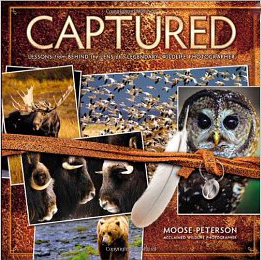
Captured: Lessons from Behind the Lens


Captured:  Lessons from Behind the Lens of a Legendary Wildlife Photographer/B. Moose Peterson, Berkeley:  New Riders, 2010 (396 p.)


Having heard anecdotal stories about Moose Peterson and looking at the title of this book, I approached it with some trepidation.  I wasn’t sure whether this was going to be a chest pounding treatise on how “good” Peterson’s photography is or a book so technical that I would put it on the shelf after reading the first chapter.  After reading it from cover to cover, I have to admit I was pleasantly surprised with the content and would recommend the book to most wildlife photographers.

There are some concerns with the book so let’s get those out of the way first:

1)      If you are looking for a step-by-step instruction book, this is not it.  Technical details and “rules” are not the emphasis of this book.  Some material also assumes some basic knowledge which may make the book less than optimal for a beginning wildlife photographer.

2)      The book contains lots of photos but is printed on a matte paper which, for some, detracts from the photo quality.  Personally I did not find this to be a problem because I purchased the book for content, not to use as a coffee table book

3)      Peterson is a Nikon shooter so if you use equipment from another manufacturer some of the details will need to be translated into what fits your equipment.  Again, I did not find this to be problematic since equipment options from Nikon and Canon are similar.  At the same time, several pages are devoted to screen shots of Nikon menus which are not useful to people who do not use Nikon equipment.
Having that out of the way, I found about 90% of this book to be highly enjoyable.  Peterson is at his best when telling stories of projects he has worked on and describing events and the environment.  Interspersed with these folksy tales are bits of technical wisdom that wildlife photographers may find highly useful (I have already made a couple of changes based on ideas he presented).  Where the book does not shine is when he attempts to go deep into theory or technology.  Luckily, Peterson warns you about this in the text.

While the book is long (396 pages, not the 312 shown on Amazon’s site), there are few, if any, pages without one or more photos.  Peterson uses these photos to compare “good” with “better”.  While admitting to not deleting “bad” photos, Peterson also says you will never see the “bad”.  These photos also make this book one that you can pick up and browse for enjoyment without reading a word of text other than the photo captions.

As I said earlier, I would recommend this book to almost anyone interested in wildlife photography.  My only caveat would be that the beginner looking for a “how to” guide may be disappointed.

Monday, February 6, 2012

Creative Landscapes: Digital Photography Tips and Techniques

FRIDAY,  FEBRUARY 3, 2012

I finished Davis’ book with mixed feelings.  The book contains a great deal of information for all levels of photographers.  It also contains examples on almost every page along with lens and exposure information and either a description of the subject, a description of technique, or both.  Unfortunately, because of the wealth of photos I found myself wanting to go back and forth between text and descriptions and photos which made keeping focus difficult.  The first third of the book concentrates more on Davis’ landscape philosophy and the final part of the book focuses more on technique.  Probably not the best book for the point-and-shoot or smart phone photographer, I would recommend this book to SLR and medium format photographers with an interest in landscape photography. Bill Fryman